10 Rules to Lift By
Strength Training 7 min ReadWe asked our coaches for their top rules to lift by. Some are advice for beginners; some took us…
Last updated September 2026
If your wrists hurt when you low bar squat, you’re not alone. It’s one of the most common complaints from people new to the lift, and the good news is it can almost always be fixed by tweaking your setup. You don’t have weak wrists.
Where it hurts tells you why it hurts. Here’s what each spot means and how to fix it.
The short version
| Where it hurts | Most likely cause | Fix |
|---|---|---|
| Thumb side of the wrist | Grip too wide | Move your hands closer |
| Back of the wrist | Grip too narrow, wrist bent back | Straighten your wrist; widen your grip slightly |
| Back of the wrist, heavy sets | Bar sitting too low on your back | Set the bar on your rear delts, just below your upper traps |
Pain on the thumb side of your wrist usually means your grip is too wide. The angle between your hand and forearm gets too sharp and pinches the tissue on that side of the joint. The photos below show a grip that’s too wide.
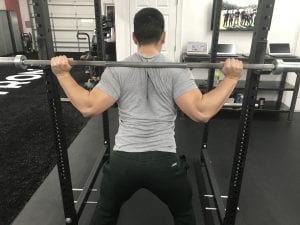

Move your grip closer, a little at a time, until the pinch goes away while the bar still feels secure.
This happens when your wrist bends back too far, so the bones press into each other. A grip that’s too narrow often forces the wrist back to get the bar into position, as the photos below show.
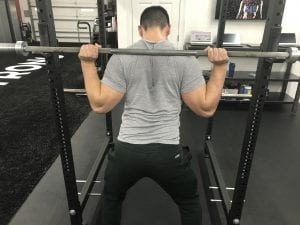

Keep your wrists straight. Squeeze the bar and actively pull your knuckles up toward the ceiling so your hand stays in line with your forearm, instead of letting the bar push it back. If you can’t get your wrists straight, widen your grip slightly.
The bar may be too low on your back. If it slides down below your rear delts, your hands end up holding it in place, and that puts a lot of pressure on your wrists.
Set the bar just below your upper traps, on top of your rear delts, and squeeze your upper back tight to make a shelf. Your back holds the bar; your hands just keep it there.
The right grip width lets you set the bar just below your upper traps, on your rear delts, with your wrists straight and no joint pain. When you’re new to the low bar squat, the position can feel tight and a bit uncomfortable at first. Some discomfort is normal; pain is not.
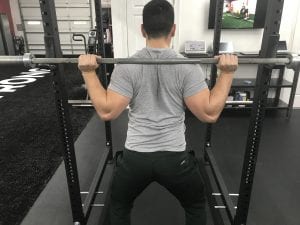
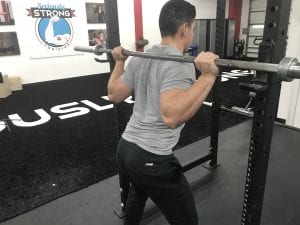
If your wrists are still sensitive while you adjust, wrist wraps can help by supporting the joint and keeping it straight. Here’s how to put them on.
Coach’s tip
Most wrist pain in the low bar squat is really an upper-back problem. When you squeeze your shoulder blades together hard and make a big shelf, the bar sits securely and your hands barely have to work.
If the pain lasts after you fix your grip and bar position, gets worse from session to session, or comes with swelling, numbness or tingling, stop squatting through it and have a physical therapist or doctor take a look.
Usually because your grip is too wide or too narrow, your wrists are bent back, or the bar is too low on your back and your hands are holding it up.
Yes. Keep your wrists in line with your forearms, with the bar resting on your back rather than in your hands.
They can, by supporting the joint while you fix your setup. They shouldn’t replace fixing your grip and bar position.
Some discomfort is common when you’re new to it. Real pain isn’t, and it usually means something in your setup needs to change.
Want a coach to check your squat setup and fix your wrist pain? Book a free strategy session at our Tallahassee, St. Petersburg or Tampa gym.